what to use to cover bad bruising on the face
Face & Cervix
Injectable Bruises? Been At that place. Here'south How to Handle Them Without Hiding Out.

In these gloriously transparent times, if a brand dares to harbor dirty laundry, information technology will most certainly be aired—if not used to hang them out to dry.
While this open-book ethos pervades nearly every industry in 2019, certain aesthetic treatments, we've noticed, seem somehow exempt. Reported side effects and complications may be voluntarily logged into a little-known FDA database or, perhaps, discussed by doctors at medical conferences; but on the whole, they tend to be downplayed to the public. So when we leave our lunchtime filler appointment, two days before our best friend's wedding, with a burgeoning black eye or needle-inflicted hickey, nosotros tin can't help simply feel blindsided.
Bruises subsequently corrective injections have us by surprise, precisely because nobody talks most them. Contusions may be covered in the consent forms y'all "sign and initial here, hither and here" prior to treatment, but injectors rarely dwell on the topic. And when black-and-blues do rise up, patients go to swell lengths to hide them. All told, our collective reticence has made injectable bruises seem like an anomaly when, actually, they're "a common and oft unavoidable" part of the procedure, says Bully Neck, New York, dermatologist Dr. Jeannette Graf.
Intermission for perspective: a bruise later injections is hardly cause for boycott. It's the price nosotros pay for beauty, some might say. And I get that. I am absolutely grateful to Botox for sparing me crow's-feet and fine lines and brow grooves; I appreciate the rest hyaluronic acid fillers bring to my crumbling face. Only when expensive "no-downtime" procedures undertaken to brand us look and feel more beautiful render the states swollen and bruised for days to weeks—well, it'south a cruel irony indeed.
Why filler bruising is more mutual than you think
More ten 1000000 filler and neurotoxin shots were administered in 2018, according to the American Society of Plastic Surgeons. And every one of those needle pokes posed a run a risk for bruising. Why? Considering the homo face is an arterial minefield, its intricacies beautifully detailed in this ofttimes regrammed analogy commissioned by aesthetic nurse Connie Brennan from artist Kevin Cease.
Practitioners who navigate injectable treatments through vascular terrain without leaving a mark have either uncanny luck or some kind of sorcery on their side. The reality is, "anyone can bruise, and it's not about Botox versus filler—it'due south associated with the needle," says Dr. Robert Anolik, a dermatologist in New York City. "If the needle happens to touch a slightly larger vessel, blood tin can be released into the surrounding skin, leaving a bruise. A blunt-tipped cannula can exist helpful in some scenarios, but if a cannula has to be pushed with great strength because information technology'southward non sharp enough to glide easily, that force can besides trigger bruising."
As Washington, D.C.–based dermatologist Dr. Tina Alster explains in a popular RealSelf Q&A, "No matter how skilled your md is, it is very difficult to avoid bruising when having fillers injected. In fact, the chances of bruising later dermal filler treatments are loftier and information technology's ane of the most common side effects—on average, 67% of patients trample, based on 22 clinical studies with more than than 2,700 patients. These FDA studies were completed by some of the nigh expert injectors in the world, which further demonstrates that bruising is common amongst fifty-fifty the almost skilled practitioners."
Related: Off-Label Is the New Blackness: The Weird New Means Doctors Are Using Filler
Living proof: bruises happen to the very best injectors
To this point, I can personally attest. Beauty editors, you may have heard, are an absurdly fortunate bunch. Chief amidst the perks of the job is open access to the world's virtually preeminent (and generous) cosmetic dermatologists. I didn't brainstorm to fully explore this privilege until several years ago, when my now 42-year-sometime face started to deflate and sink.
I had only turned 38 when I visited Dr. Graf for my commencement dose of filler—a unmarried syringe of Voluma, split between both cheeks, to subtly hike my midface and smoothen my smile lines. Thoughtful, gentle and precise in all she does, Dr. Graf has flawless technique—all the same I still left her that day with a faint smattering of pinpoint bruises. In hindsight, they were minor and disappeared later a week or so; but at the time, I was nothing brusque of distraught—wholly unprepared for this perfectly normal response to having a needle pierce my peel.
In the years since that first stick, I've seen a number of dermatologists for filler injections. Salvage for one or ii lucky shots, I've hobbling fairly consistently. During that stretch, I've also reported extensively on the potential pitfalls of injectables, familiarizing myself with fifty-fifty the rarest of risks—stuff manner scarier than bruises, like incomprehension and skin expiry resulting from filler-blocked arteries. With these could-exist horrors forever embedded in my brain, I at present view every trample every bit a potential emergency.
And withal… I go back.
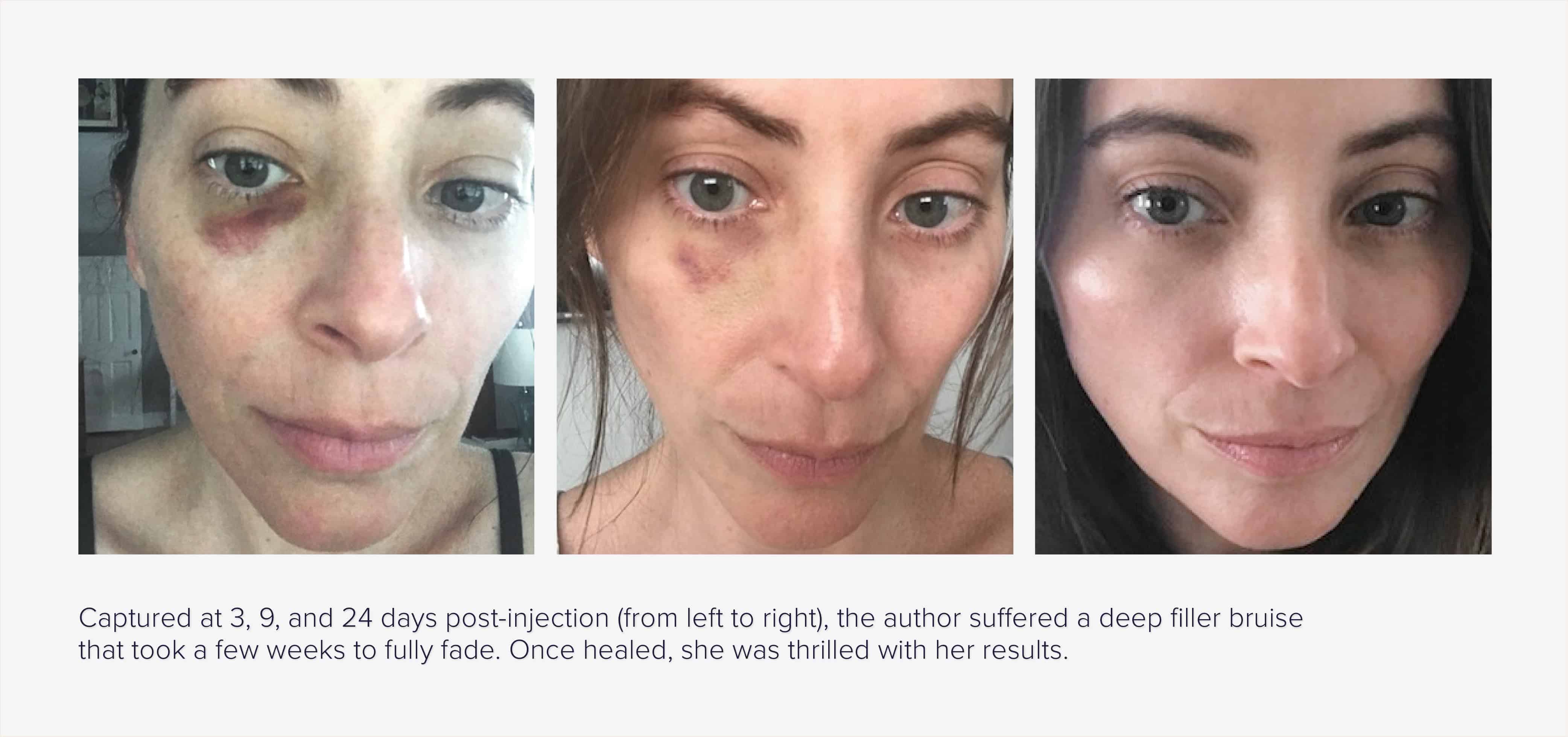
In the summertime of 2018, I met up with an old friend in New York City, and together we paid a visit to Dr. Anolik, an skilful injector who injects Manhattan'southward elite on a daily basis. Toward the end of my session, he grazed a vessel near the top of my right cheekbone. The area swelled and darkened about instantly as blood filled my tear trough and eventually bloomed into a total-on shiner. I overreacted in equally dramatic fashion. Dr. Anolik nevertheless regrets giving me his cell number. (J/thousand—he called and texted regularly following my engagement.)
My black eye lingered for almost iii weeks, and I did my best to veil it with concealer and oversize shades—all the while refraining from posting selfies, because a) not pretty and b) I worried (needlessly) that sharing what had happened might irk my md. With an utterly unbruised ego, Dr. Anolik chalked it up to bad luck and said he sees bruises of such severity "mayhap twice a year."
This past June, I scored an date with another famously vivid dermatologist, who I've interviewed countless times (she requested anonymity here—something I offered to everyone). After assessing my sinking face, she filled my hollow temples and and then injected my chin, aiming to protract information technology back to a youthful position that would better balance my naturally strong cheekbones. Equally bruises began to surface on my temples, she zapped them with her Vbeam light amplification by stimulated emission of radiation.
It wasn't until hours after, when I was on a railroad train dorsum to Providence, that my chin fully freaked out. I snapped some unflattering selfies in the Amtrak bathroom and texted them to my injector, who quickly reassured me that all looked normal. By the time I got home that evening, my chin was bloated and stained with violet streaks. (Mentum bruises tend to bleed downwardly, leaving drippy trails.) My kind and understanding doc prescribed prednisone (for the swelling) and a night without worrying (a harder pill to swallow).
The next twenty-four hour period, Dr. Caroline Chang, a dermatologist in nearby East Greenwich, Rhode Island, fortuitously reached out, inviting me in to try the new blood vessel-targeting Aerolase Neo laser she happened to be road testing. She treated my bruises, and a week later, they were almost invisible.
Related: What Information technology's Really Like to Get Fillers Dissolved
Filler bruising: what to exercise if it happens to y'all
Being a "bruiser" has taught me what works to speed healing and what doesn't—for me, anyway. I'm hoping you lot can extrapolate something useful here, merely keep in mind: your body may respond differently—what failed me could very well save you. Here'southward what I've come to know.
- Certain parts of the face—namely, the under-center area, the crow's feet, the mentum and the lips—are more apt to trample. "Only information technology tin can happen anywhere, anytime," Dr. Anolik notes. To be safety, don't schedule injectable appointments within two weeks of of import events.
- "Some patients are naturally more prone to bruising—they tend to have thinner, more sun-damaged skin," says Dr. Graf. (I'll try not to take criminal offence.)
- The usual spiel nearly avoiding blood thinners for one to two weeks before filler injections (and, some say, one to two days afterward) is pretty sound. According to Dr. Anolik, steering clear of "things that tin encourage bleeding, such as aspirin, ibuprofen, alcohol, fish oil and vitamin Due east, can aid limit bruising." (FYI, along with the specific ones mentioned, in that location are many other common supplements that can increase the likelihood of bruising, including ginkgo, ginseng, st. john's wort, and flaxseed oil. And it's likewise a good idea to avoid over-the-counter NSAIDS—Aleve, Motrin, naproxen—in full general. Instead, stick with Tylenol.) Accent on the word limit. Abstinence hasn't always worked for me, simply my most gruesome black-and-blue to date did occur on the heels of an Advil-medicated migraine. Proceed in mind that many prescription medications, such equally Warfarin, can also increase the likelihood of bruising, so make sure to talk over that with your injector ahead of time.
- Arnica montana—tin't injure, might help. The bulk of bear witness supporting the herb's anti-bruise benefits is anecdotal. I've experimented with the homeopathic tablets, over-the-counter arnica gels and creams, doc-dispensed rollerballs, even those OcuMend high-potency hydrogel patches that derms are wild about—all to no avail. However, Nanuet, New York–based dermatologist Dr. Heidi Waldorf calls the OcuMend pads "a game changer for bruising." The key, she says, "is slapping them on before you trample, immediately afterwards injections"—ideally, covering the whole confront and not merely the injection site, then leaving them on for six hours before replacing them with fresh pads for six more than hours, and and then on. "They won't proceed you from bruising if a vessel was hit, merely they can reduce the slow, leaky bruising that tends to develop on solar day two."
- Icing: If your injector nicks a vessel, they should put pressure on the treated area right abroad and brainstorm icing ASAP. Water ice acts as both an anesthetic and a vasoconstrictor, explains Dr. Waldorf, cutting down on hurting and early claret seepage. She recommends icing for x–twenty minutes per hr, for the showtime two days, while awake. Personally, my bruises have come on so fast and furious that ice packs were no match.
- Topical vitamin K oxidase I have not withal tried, just Dr. Graf says "it breaks up hemosiderin—the hemoglobin paint of bruising." Employ it three times daily, starting right after injections. (You can find it in a product called Auriderm.)
- Lasers can slash healing time—in sure situations. When Dr. Anolik zaps bruises with his pulsed dye laser in the days following injections, he often sees them "vanish in a matter of hours," he says. One exception: if the bruising is widespread after an isolated needle stick or accompanied past underlying swelling, it may exist likewise deep for the laser's energy to attain (such was the case with my black eye). In one case it's partially healed and appears more purple (versus black) and surface-level, then lasering may assistance fade it the rest of the manner. Likewise, Dr. Chang has found that her Neo (a type of Nd:YAG laser) can cut healing fourth dimension in one-half. (Worked for me!)
More crucial than any of this advice is knowing when a bruise is non just a bruise but rather a sign of vascular occlusion (filler inside a vessel, blocking blood menstruum to the skin). If the area of discoloration has a dusky, netlike advent and is exquisitely painful mail service-treatment—as in searing, keeps-you-upward-at-night hurting—telephone call your injector right abroad, says Dr. Waldorf, "because delaying diagnosis and treatment is almost unsafe."
How to cover bruises from injectable fillers
The right concealer is everything. Since I very well may be the world'southward worst makeup artist, I reached out to 1 of the globe'south best: Sandy Linter, who'south camouflaged her share of filler bruises. "You'd be surprised how easy they are to hibernate—and without a lot of fussing," she says. Her secret weapons: This Kryolan Dermacolor Mini Concealer Palette—the conception "adheres to skin immediately"—and a good concealer castor (she uses the Kevyn Aucoin). To build coverage, she explains, "many times I kickoff with a deep pink—it seems to disguise or lift the black. Then I'll add a deeper skin-tone shade and touch up the top with a colour closest to my skin tone [or the client's] before dusting on a fleck of powder or applying foundation. The lightest touches work really well."
The bottom line on filler bruising
Bruising after injectable fillers can exist downright devastating (no exaggeration), only endeavour not to panic. Inquire your injector what they tin can do for y'all in the moment, or perchance a few days afterwards, to fast-runway healing. And consider mining your friends and coworkers for tips—odds are, they've been on the losing end of a needle before likewise and tin can help guide y'all out of the darkness.
vanbuskirkfingthily.blogspot.com
Source: https://www.realself.com/news/bruising-after-injectable-filler
0 Response to "what to use to cover bad bruising on the face"
Post a Comment